
- industry insights
Sound Search #4: Amy Hegarty, Synchtank
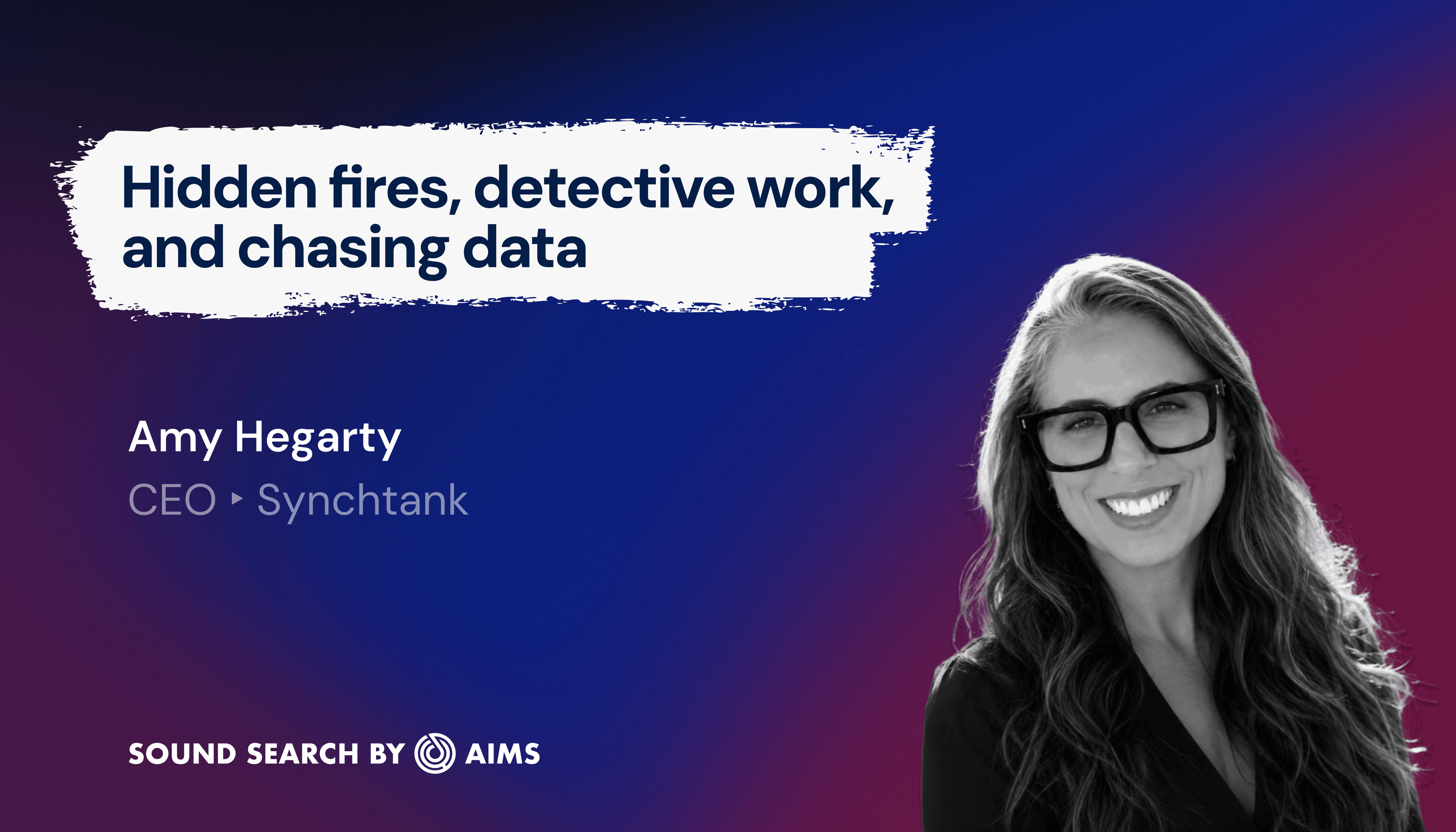
Amy Hegarty is the CEO of Synchtank, the platform that brings assets, metadata, rights, licensing, royalties, reporting, and workflows together into one connected system.
Amy brings a SaaS operator's perspective to the music industry. Over 20+ years she's scaled organizations from startup to Fortune 500 as a go-to-market leader, including taking one Series A company from $9M to $22M in 22 months. What she found when she arrived in music surprised her: a sophisticated, data-dependent business still running on disconnected systems, manual processes, and spreadsheets.
We talked to Amy about why music has tolerated bad data for so long, what messy catalog data actually costs in terms a CFO would recognize, what "ethical AI" means in practice, and the detective work she still can't quite believe insiders accept as normal.
You came into music from SaaS and revenue roles, not from inside the industry. What was the first thing about how music handles its data that genuinely surprised you?
What surprised me the most about the music industry is that it's completely dependent on data, yet so much of that data is still being managed manually. Every royalty payment, licensing deal, sync placement, and ownership claim relies on accurate metadata. But behind the scenes, a lot of teams are still working across spreadsheets, email chains, and disconnected systems to keep everything moving.
It's an industry built on data, but many organizations are still spending too much time chasing it instead of using it.
In SaaS, broken data gets treated as a fire to put out. In music it often feels tolerated as just how things are. Why do you think the industry has lived with it so long?
In SaaS, bad data gets treated like a fire because everyone feels the impact immediately. The product breaks, reporting is wrong, revenue is affected. Something is forcing the action.
In music, the impact of bad data is often spread across a lot of different companies and teams. A metadata issue might delay royalties, slow down a licensing deal, create extra work for operations, or leave money sitting unclaimed somewhere. The cost is real, but it's often hidden. The other thing is that the industry wasn't built around a single source of truth. Rights data lives in different systems, with different standards, owned by different organizations. So instead of fixing the root cause, people got really good at working around the problem.
I think we're reaching a point where that approach doesn't scale anymore. Catalogs are getting bigger, teams are staying lean, and everyone is being asked to do more with less. The cost of bad data is becoming a lot more visible than it used to be.
What does bad catalog data actually cost a rights holder, in terms a CFO from outside the industry would immediately understand?
If I were explaining it to a CFO, I'd say bad catalog data ties up cash, increases operating costs, and makes it harder to make good business decisions.
When ownership information is wrong or incomplete, revenue gets delayed, licensing opportunities take longer to close, and teams spend time fixing problems instead of creating value. Most CFOs wouldn't tolerate that in any other part of the business, and music is no different. The difference is really that in music, those costs are often hidden inside operational workflows rather than showing up as a line item called "bad data."
You've called your approach "ethical AI." What does that actually mean in how Synchtank builds?
When I talk about ethical AI, what I really mean is AI that keeps humans in control. We help rights holders manage some of their most valuable assets, so trust, transparency, and ownership are incredibly important. AI can help people find information faster, improve data quality, and automate repetitive work, but human expertise and decision-making still matter.
For us, it's not about replacing people. It's about helping people make better decisions and get more value from their data while respecting the rights and ownership that the industry is built on.
You've seen tech cycles in other industries. What stage is music's AI moment really at? What does that tell you about what comes next?
I think we're still very early. There's a lot of excitement around AI right now, but most organizations are still trying to separate what's genuinely valuable from what's just interesting. I've seen enough technology cycles to know that the companies that get the most out of new technology aren't usually the ones chasing every trend, they're the ones focused on solving real business problems.
What comes next is AI becoming less of a headline and more of a tool that's embedded into everyday workflows. The biggest opportunity isn't replacing people; it's helping them work more efficiently, make better decisions, and spend less time on manual, repetitive tasks.
I actually think we're going to stop talking about AI in a couple of years. It'll just become part of how people work, the same way nobody talks about cloud software anymore.
The conversation will shift from "Do you have AI?" to "Does it actually help people do their jobs better?"
What's the most common mistake you see rights holders make when they go shopping for new tech?
The biggest mistake is thinking the technology is the problem when it's really just the process behind it.
I've seen companies spend months evaluating platforms, comparing feature lists, sitting through demos, and then implementing a new system only to realize they've automated the same broken workflow they had before.
We've all been guilty of falling in love with a great demo, myself included. The challenge is separating the features that look impressive from the ones that are actually going to move the business forward. The best buyers start with the outcome they want and work backwards from there.
What's something insiders accept as normal that you, coming from outside, still think is a bit crazy?
The amount of detective work people have to do just to answer what should be simple questions.
I've met some incredibly talented people in this industry, and sometimes they're spending hours trying to answer what should be a pretty simple question: who owns this, where's the agreement, what's the latest version, why don't these numbers match?
And everyone just kind of shrugs and says, "That's the music industry" and everyone just nods as if it's completely normal.
Coming from SaaS, where bad data usually triggers alarms, I remember thinking "Wait…this is really how we're doing this?". But it's also why there's such a huge opportunity to improve the way the industry manages information and works together. The talent is there. The knowledge is there. It's just really hard to get at it. The industry doesn't have an information problem, it has an accessibility problem.
For someone running a label or publisher who knows their data is a mess but doesn't know where to start, what's the one thing you'd tell them to do first?
First thing: Don't try to fix everything at once.
The first step is understanding what you are actually trying to solve for. Are you trying to speed up licensing? Improve royalty accuracy? Make your catalog easier to search? Support growth? Once you're clear on the outcome you're trying to achieve, it becomes much easier to identify what data really matters and where to focus your efforts.
I'd also say don't assume you have to do it alone. Most organizations have better data than they think, they just don't have a clear picture of where it lives, how reliable it is, or how it's being used.
Start with an assessment, build a plan, and tackle the highest-impact issues first. The goal isn't to be perfect. The goal is giving your team the confidence to make better decisions every day.
This interview has been edited for length and clarity.
Sound Search is AIMS' interview series with music professionals on how technology is changing the way we discover and work with music.
Have someone in mind we should talk to? Reach out to us on LinkedIn.